Professional.
Local. AI.
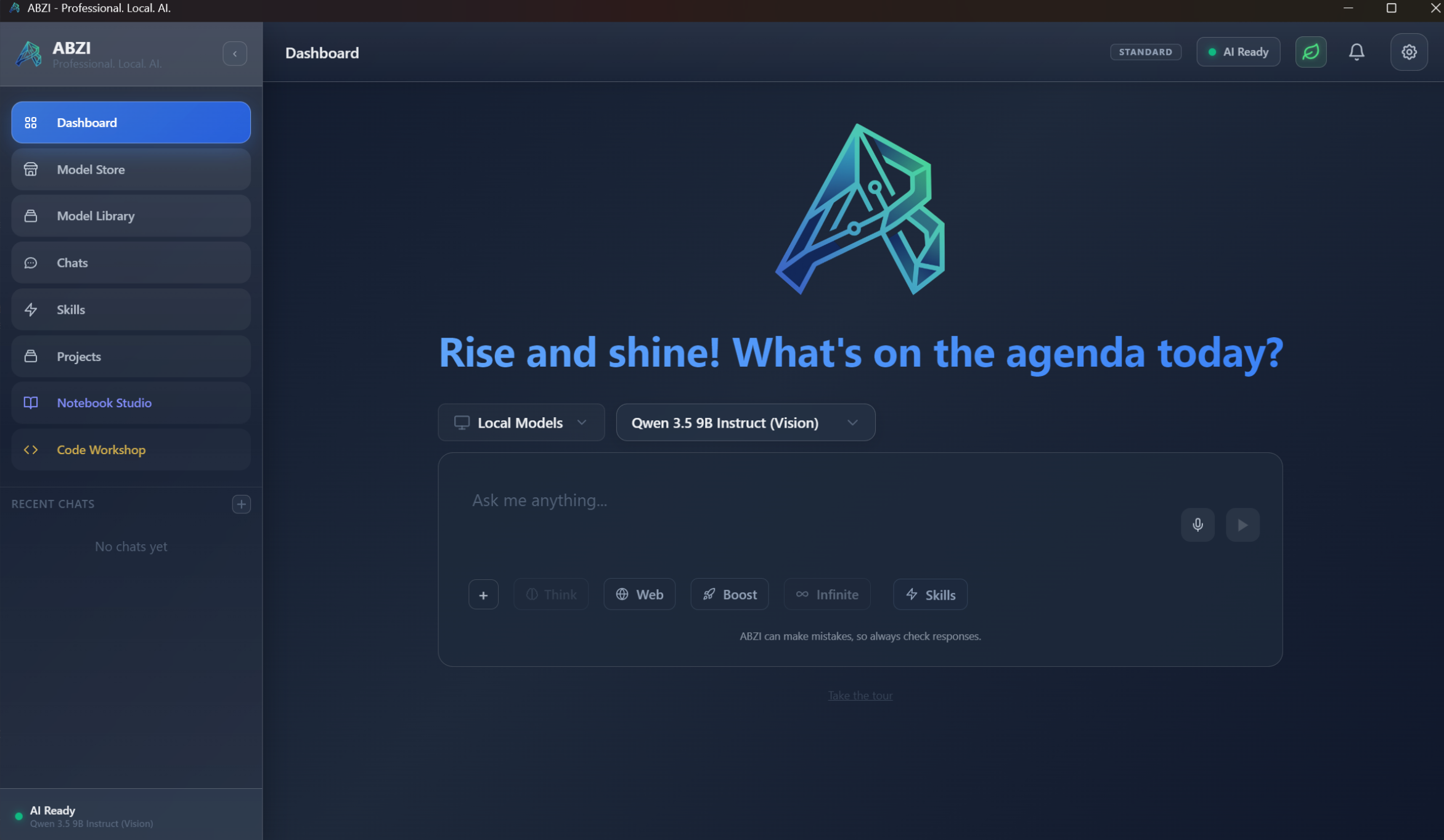
ABZI is a local AI platform for Windows. It runs entirely on your hardware. Own your conversations, your code, and your research.
Roadmap: Linux WSL2 · macOS
Works on Windows 10/11 (64-bit) PCs · GPU recommended for best performance (NVIDIA or AMD)
Not sure what you have? ABZI checks for you on first launch and tells you exactly what to expect.
What makes ABZI different?
Chat, a real coding workspace with diffs and restore points, document Q&A with citations, and web search — all in one place, all local.
Your conversations, code, and research are processed on your own hardware. No account, no cloud, no exceptions.
Local models handle the everyday 90% for free. Save the $20/month subscriptions for what actually needs them.
Standard is free forever. Pro's price is locked in writing until 2030. No surprise upgrades, no bait-and-switch tiers.
How ABZI is different from the others
LM Studio is a genuinely good model runner with a polished GUI — if you want to download a model and chat, it works great. But it stops at chat. ABZI starts there and builds the rest of the workspace on top: coding, research with citations, voice, projects. Same foundation, different ambition. A model runner versus a platform.
Ollama is a fast, efficient inference engine beloved by developers — and it has earned that. It ships a simple desktop app now, but it remains developer-first: configuration and most real capability still live in the terminal. ABZI runs llama.cpp under the hood for the same performance, wrapped in something a teacher, a writer, or a small business owner can use on day one without reading documentation.
Good chat interfaces, and Jan deserves credit for being genuinely easy to install. Open WebUI is powerful but assumes you're comfortable hosting your own web app. Both are focused on the chat itself. ABZI's focus is everything around the chat — the coding workspace, the research tools, the voice, the projects that make a chat window into a place you actually work.
An excellent product — and $20/month, forever, with your code passing through their servers. You don't own it, you rent it, and the pricing has already shifted once. ABZI Code Workshop is local, your code never leaves your machine.
An open-source, MIT-licensed terminal coding agent, and genuinely excellent at what it does. We're not competing with OpenCode — we're grateful for it. Its success proves developers don't want to be locked into proprietary platforms, which is exactly the belief ABZI is built on. OpenCode is for people who live in the terminal. ABZI Code Workshop is the same principle for everyone else: native GUI, no terminal required.
The honest summary: these tools are good at what they do, and we're not here to trash them. We're here because none of them are trying to build the complete platform — one any person can install in minutes, that protects their hardware, scales with their work, and respects their data. That's the gap. That's what we're building.
Side by side
| Feature |
ABZI
|
LM Studio | Ollama | Odysseus | Cloud AI ChatGPT · Claude · Gemini |
|---|
Ollama install ◐: Ollama has a desktop app, but most features and model management still live in the terminal. Document Q&A ◐: LM Studio has built-in document RAG but no source citations; Odysseus has vector memory (ChromaDB); Google's NotebookLM is a separate cloud product. Cloud key ◐: LM Studio can reach external providers only through a community plugin; Ollama has first-party cloud routing. Long context ◐: Gemini offers a 1M+ token window; ABZI Infinite Mode extends usable context up to ~10M tokens. Skills ◐: Odysseus supports custom agents; cloud products offer Custom GPTs, Projects, and Gems on paid plans.
A lot of people hate AI right now.
They're not wrong.
The anger is real and a lot of it is valid. Jobs taken without warning. Mountains of slop. Billions extracted in subscriptions while training on work people never consented to share. We're not going to tell you we've solved any of that. We haven't. Nobody has. ABZI is one person trying to build something that creates a few less of those problems — starting with the one on this page that gets talked about least: what AI does to the physical world around it.
Data centers already consume more electricity than most countries
A June 2026 UN University report found that global data centers used 448 trillion watt-hours of electricity last year — more than all but 10 countries on Earth. By 2030 that number is projected to reach 945 terawatt-hours. In Ireland, data centers already account for 21% of all metered electricity, exceeding every household in the country combined. The national grid has paused new data center approvals until 2028. Every query you send to a cloud AI contributes to this.
AI will consume as much water as 1.3 billion people by 2030
Data centers require enormous amounts of water for cooling. Last year they consumed 1.2 trillion gallons globally. Communities are already fighting back: in Uruguay, a data center was built during a drought that left the country's largest city without safe tap water. In Mexico's Querétaro region, planned data centers threaten already-scarce water supplies. In the US, community opposition led to $98 billion in data center projects being blocked or delayed in just three months of 2025 alone.
Communities are saying no. Loudly.
In 2026, lawmakers in more than 30 US states have introduced over 300 bills related to data center growth. More than 230 environmental organizations have called on Congress for a national moratorium. Residents near Memphis protested xAI's use of gas turbines to power a data center. New York and Maryland are considering multi-year construction halts. Per the UN report, AI data centers produced 208 million tons of CO₂ last year — comparable to Argentina's entire national output. The pollution is real. The noise, the light, the heat, the strain on local infrastructure — all real. And the people protesting it are right to be angry.
We're not solving the AI environmental crisis. We're opting out of contributing to it.
When you run inference locally, your query never touches a data center. No rack of servers spins up on your behalf. No cooling water is drawn in a drought-stricken region for your request. Your GPU does the work — hardware that already exists, on your desk, adding zero demand for new data center construction.
Here's the honest version of the energy math, because most "green AI" claims don't survive scrutiny and ours should. A hyperscale data center batching thousands of users onto shared hardware is genuinely efficient per token — we won't pretend otherwise. The real waste isn't where the computing happens. It's the size of the hammer: frontier reasoning models can burn 70x+ the energy of a small model on a single response. Routing every email, summary, and draft through a trillion-parameter system in a server farm is the rocket ship problem all over again. ABZI's answer is right-sizing — a small local model for the everyday 90%, and the energy footprint that comes with it.
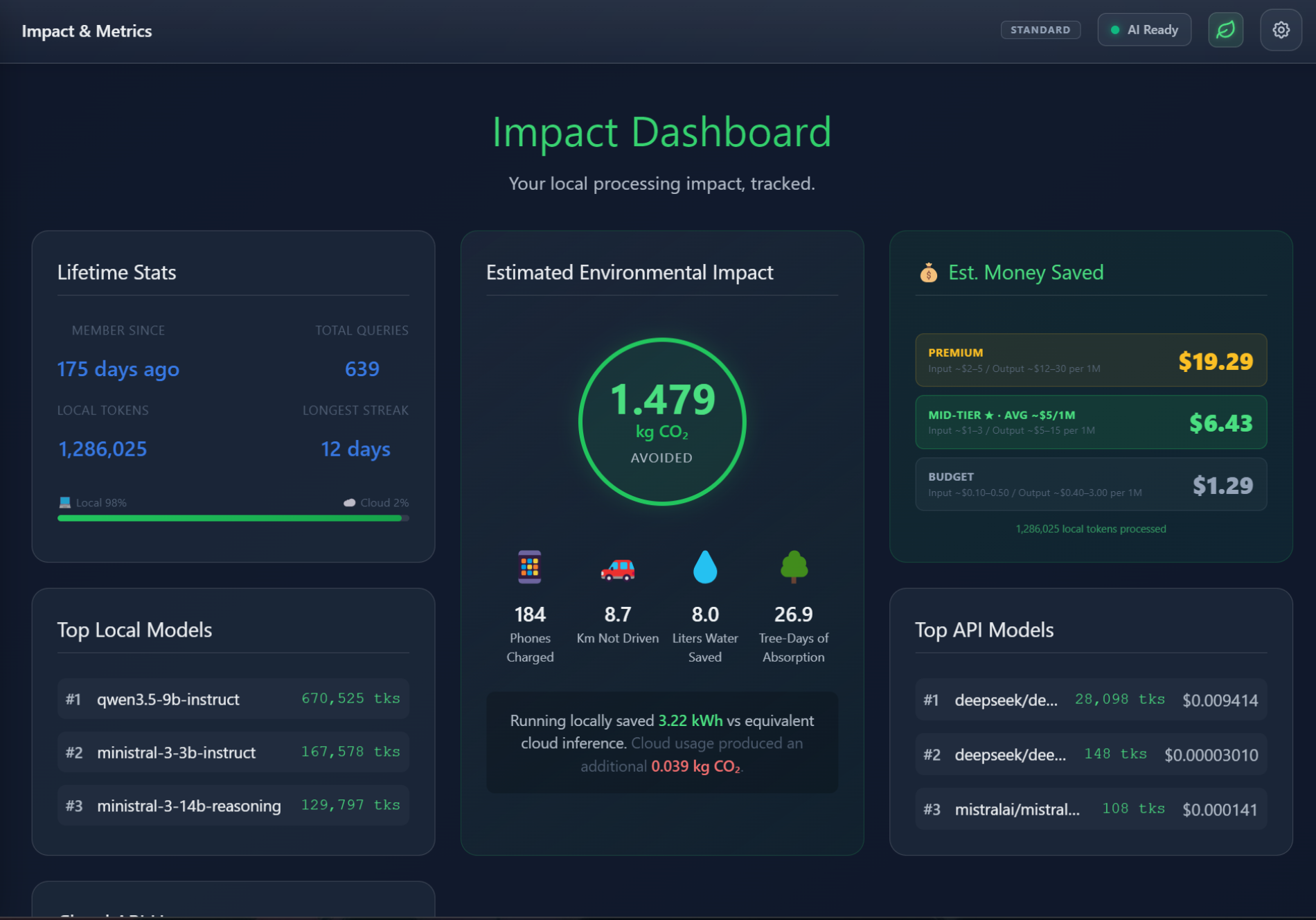
ABZI's environmental dashboard estimates what your session would have cost in energy if the same work had been routed through frontier cloud models. We do this to make the real cost of AI visible. You deserve to know what you use to make better choices.
This doesn't fix the industry. But it's a real step in the right direction — and we'll keep taking more of them.
Let's talk honestly about your electricity bill.
One honest point regarding electricity: running local AI does use power (obviously). But it's not much different from what people already do with gaming PCs. Long gaming sessions and long local AI sessions draw comparable power, and in most real-world cases the cost is still significantly less than people assume.
If you're running inference 24/7, sure, you've got a real cost over the course of the year— no argument. But that's not how most people actually use LLMs. A few hours a day, same as a gaming session, and the math just isn't the scary number some people might throw around.
And if you genuinely need agentic workflows running around the clock? You're probably already paying $200/month for cloud models to do that (aka $2,400 a year). That's exactly where hybrid comes in. Local for the 90% of what you do every day. Cloud, on your terms, when you actually need the horsepower. That's the model. That's what ABZI does.
Not just a chat window.
A complete AI platform that replaces tools you're currently paying $20/month each for. All local. All private. All on your hardware.
Chat Platform
Conversation branching, bookmarking, multimodal support, and mid-conversation model switching. ABZI Boost restates your original ask at the end of every prompt — preventing the model from drifting away from what you actually wanted. Compact manually or let auto-compact handle it silently. Most local AI tools start forgetting things halfway through a long session. ABZI doesn't.
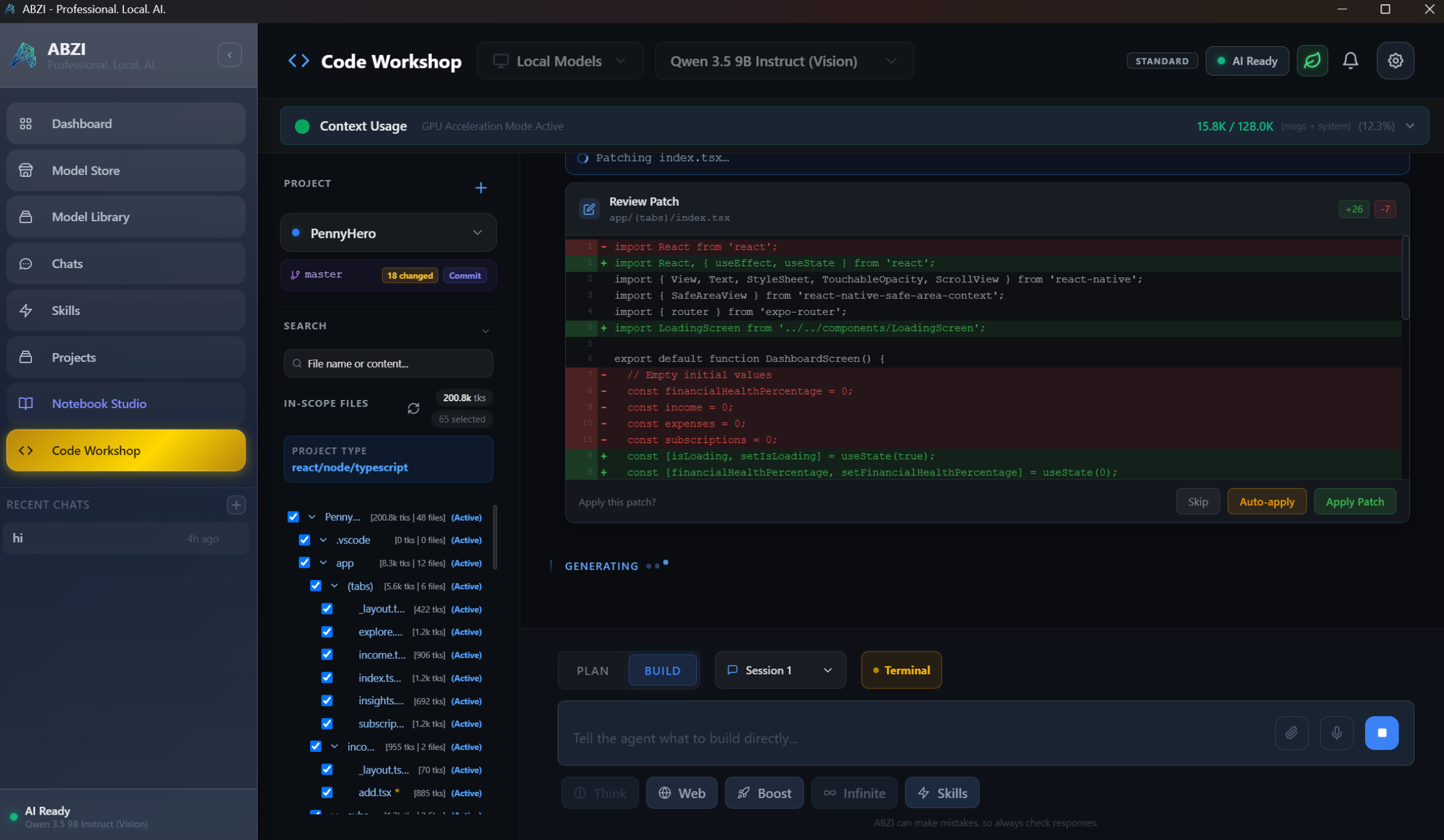
Code Workshop
Local Cursor alternative. Light Git integration, Monaco editor, restore points, diff view, and agent execution. Auto-compact keeps the agent focused across long sessions without losing the thread of your project. Your code stays yours.
Notebook Studio
Local NotebookLM alternative with ABZI Intelligence — hierarchical RAG, SmolLM2 indexing, three-layer query routing, and citation-linked answers. Notebook compaction preserves your sources and their relationships even as sessions grow long. Your research stays intact.
Writer Workshop Coming Soon
Emails, Documentation, Novel inconsistencies, pattern detection, clean up, style matching, AI writing actions, etc. Various export options. Private by default. Arriving shortly after BETA launch.
ABZI Web
Web search built into every chat — Perplexity-style answers, organized and sourced, not a list of links. Powered by Scout, a tiny local agent bundled with ABZI that turns your conversation into precise queries, then strips the ads and SEO fluff so your main model only sees clean facts. No API keys. No setup. The only thing that leaves your machine is the search query itself.
Projects & Skills
Organise work into persistent projects. Create Skills — custom AI instructions — and group them into one-click presets.
API Server & MCP
OpenAI-compatible local API server. MCP integration. Connect your own tools to your local models.
ABZI Store
30+ hand-picked models ready to go — matched to your hardware. Want more? Browse thousands of GGUF models from HuggingFace directly inside ABZI. Click to install. No terminal. No manual downloads. Done.
Every local model is free. You pay nothing to run them — ever.
Want GPT-5.5, Claude Fable, or Gemini 3.5 too? Connect your own API keys. Use the best tool for each job — swap models mid-conversation without losing a beat.
Environmental Dashboard
Estimated energy saved vs routing your work through frontier cloud models — tracked every session. Honest and visible.
ABZI Prototypes
Claude Artifacts — but local. Ask the AI to build something and preview it instantly in a click: HTML, React, and SVG. No copy-paste. No dev server. Just a local, sandboxed live preview.
Talk — Local TTS
Hit the speaker button on any response and hear it read back. Powered by Kokoro-82M on your GPU. Multiple English voices. Skips code and think blocks automatically. No cloud. No API key.
Dictate — Voice Input
Speak your prompts instead of typing. Whisper runs locally — accurate, fast, and completely private. Works across chat, Code Workshop, and Notebook Studio.
Multi-Language Support Coming Soon
ABZI's interface and local model support for 8+ languages is in active development. Local models already handle multilingual input and output (use skills for this)— full UI localization is coming. Your language. Your machine.
Linux & macOS Coming Soon
Linux support via WSL2 is in active development. A native Linux binary is next. MacOS follows after. Windows first, done right, then everywhere else.

Why I Built ABZI
I'm tired.
Tired of the status quo. 18+ months ago I started on a journey out of sheer frustration for something that simply didn't exist. At first, I was blown away by AI. The possibilities were endless. Doors were suddenly open to me that were previously only a dream. After a while I started to see the problems like everyone else.
I will preface this by saying I have two kids, a full time job, and started building something on the side not because I wanted to, but because I had to. No one else was doing the thing that I thought was obvious. At least not in the way I personally wanted. The price of doing these things separately required a lot of research and work. I got there, but by then my mind was made up. One platform, all purposes, honest, not controlled by a few companies that want your money and data on their terms.
Let one thing be clear. This might be obvious, but you don't need a PhD-level intelligence to write an email. To summarize a document you already own. To organize your notes, search your own files, write a first draft. These are everyday tasks we do a thousand times a day. Somewhere along the way the industry decided you did. They said only the most powerful AI ever built was good enough for your daily workflows. Then they built a subscription around that idea.
Now, local models are not GPT-5.5 or Claude Mythos [or insert your super mega ultra model of the month here]. Open source hasn't beaten the frontier (yet). But they're doing things today that would have required frontier models a year ago. The gap is closing fast. Qwen 3.5/3.6 and Gemma 4 are proof of that.
Here's what I've actually built: Of course we have normal chat and vibe coding (everyone has this). We have projects that work like Claude, only local. I built a Code Workshop for developers who want a local alternative to Cursor (yes, I am aware of OpenCode and do love it too) and tools like Aider and Cline. I created Notebook Studio for researchers: upload your documents, ask questions, get answers with citations. Like NotebookLM, but private. On your machine. Nobody else's. And ABZI Web for when you want answers from the web the way Perplexity gives them. Organized, sourced, not a list of links to click through. The reading and refining happens on your machine — a small local agent strips the junk from the results and hands your model just the facts. The only thing that ever leaves your machine is the search query itself. No account, no profile, no history stored anywhere but locally.
One platform. Everything in one place. Completely local, secure, and environmentally conscious.
I am not doing this because I claim it's better than every tool out there. I am doing this because you shouldn't need five different subscriptions and five different logins to do your best work. Nor should you need to be a developer or work in Software/IT to understand how to get it to work on a machine in the first place.
I don't know about you, but I'm tired of paying $20 a month or more for Claude. Another $20 for Cursor. $10 for Midjourney. Subscriptions stacked on subscriptions, each one promising to make my life easier, while quietly making my wallet lighter and tightening their limits, so I get less and less over time.
More recently, I love the quiet emails that arrive on a Tuesday. "We're updating our policies and pricing to better reflect the value we provide." What they mean is: we have you now. You built your workflow around us.
And if you want real usage, it's $100 to $200 a month now!?
$20 was originally just something that "sounded good." The head of ChatGPT admitted it was picked to turn away casual users. Not based on value. Not based on cost. Just: what price makes people think twice?
Everyone else followed. Claude. Gemini. Copilot. All $20.
It certainly hasn't gotten better.
And the cost of these superpowers besides money? Every conversation you have, every document you write, every idea you share — it's going somewhere. Training their models. Product improvement. You clicked agree. Remember?
OpenAI started as a non-profit with one goal: benefit humanity. That was the mission. That was the promise. They changed that mission statement six times in nine years. In 2025 they removed the word "safely" entirely.
You can decide what that means.
These platforms are not designed to care about you or your interests. You are not the mission. You are the revenue.
But that's just one side of it. Here's what doesn't get talked about enough: Data centers consumed more electricity last year than all but 10 countries on Earth. Communities are fighting proposed data centers to protect their water supply. 208 million tons of CO₂ last year — comparable to Argentina's entire national output. Every query to a cloud AI is a small piece of that. ABZI tracks what you save by running locally, right there on your dashboard, every session. Not to make you feel better. Just to make it visible.
I don't answer to a board. I'm not chasing a billion dollar valuation. I'm not trying to extract maximum value from you before the next funding round. I have bills like everyone else. I'm just trying to offer a different path.
Don't believe me? Good. Try it. It's free. Not a trial. Not a preview. The core of what ABZI is — free. No expiration date.
As I add more I'm not moving the foundation. Pro is there for people who want to go deeper. But I'm not building a wall between you and something useful just to upsell you.
My goal is never to give you "just enough" to then make you pay.
It's time to come home.

— Chris, Founder of ABZI
Something is shifting.
I'll give credit where it's due. This dude beat me to it. 🙂
On May 31, 2026, PewDiePie — one of the biggest individual creators on YouTube with 110 million subscribers — released Odysseus. A free, open-source, self-hosted AI workspace. His words at launch: "The war on big tech has just begun."
In 48 hours it had over 30,000 GitHub stars. In one week, more than 60,000. For context — most venture-funded AI startups never reach that number in a year. He didn't spend $50 million building it. He spent a year, used AI to write most of the code, and gave it away for free. Because he was tired of sending his data to big tech companies.
That reaction wasn't about PewDiePie. It was about the frustration being real. Tens of thousands of people saw Odysseus and immediately understood what it represented. The demand for local, private, owned AI is not niche. It is mainstream and it is growing.
What is Odysseus?
Odysseus is a real project and it matters. We respect what it represents. But it is a self-hosted web app — it requires Docker, Python, and a comfort level with running server software on your own machine. The install experience is still technical. The developer community is already building a native wrapper for it, which tells you something.
ABZI is a Windows installer today. Linux support via WSL2 is in active development. A native Linux binary is next. MacOS follows after. Windows first, done right, then everywhere else. Different audience, different approach, same fundamental belief: your AI should belong to you.
We all knew this was coming eventually.
I'm going to address the elephant in the room. Governments are now deciding what AI you're allowed to use. Taiwan has banned multiple Chinese-built AI systems. Italy temporarily banned ChatGPT. The EU restricts specific use cases under the AI Act. More than 300 bills have been introduced across 30+ US states in 2026 alone.
That's not hypothetical — it already happened, twice, to the same company in one year. In March 2026, the Department of Defense labeled Anthropic a "supply chain risk" after it refused to let its tools be used for autonomous weapons; a federal judge blocked the designation, and Anthropic sued. Then in June, the Commerce Department separately forced Anthropic to disable its newest flagship models — Mythos 5 and Fable 5 — worldwide, for every user, days after launch, after a security researcher demonstrated a technique for jailbreaking their cybersecurity capabilities. The models stayed dark for nearly three weeks. Access came back in stages — a small group of vetted organizations first, then the wider restoration — only after Anthropic agreed to new government-approved security commitments. And per the government's own letter, those restrictions can be reimposed if it decides Anthropic hasn't held up its end. Not resolved. Just paused. [Al Jazeera] [Forbes]
Access came back — this time. But notice what actually happened: millions of paying users lost a tool they'd built workflows around, overnight, over a dispute they had nothing to do with, with no say and no recourse. Whether the gate is a government directive or a lab's own policy, the result for you is identical: someone else decides what intelligence you're allowed to use, and that decision can change while you sleep.
Frontier intelligence is becoming granted access, not a product you buy. And what's granted can be (and will likely be) taken away. Your local model is neither.
But here's what's getting less attention: it's not just governments acting alone. The biggest AI labs are actively lobbying for regulations that — by design or coincidence — lock out every competitor. Safety language used as a moat. Compliance costs that only billion-dollar companies can absorb. Staggered model releases that keep frontier intelligence away from independent developers and smaller teams. Regulatory capture dressed up as responsibility.
A local model running on your machine answers to neither. Not to governments deciding which AI is permitted. Not to the companies lobbying to shape those decisions in their favor. No directive reaches it. No export control applies. No server goes dark overnight.
Will open models eventually face the same restrictions? Most likely. As local models become more capable the regulatory pressure will follow. I'm not pretending otherwise. But there's a meaningful difference between regulating five cloud companies and regulating software running on millions of private machines. Regulating five companies is one conversation. Regulating software on millions of private machines is a very different one.
And in the meantime: every day you choose to run local AI is a day your data stayed yours, your work stayed private, and your tools worked on your terms. That's worth something regardless of what happens five years from now. We don't need the frontier's most restricted model to do everything for us. Models that we currently call "just okay" will handle 90%+ of what you actually need. Will they one-shot every task? No. But is that really such a bad thing?
Get ABZI for Windows.
One installer. Everything runs on your machine. Free to start — a license key unlocks Pro.
That's expected right now. The installer is digitally signed by Mynml LLC — you can verify it under the file's Properties → Digital Signatures. Windows SmartScreen still warns until a new app builds up download history, and as a small independent company we're at the start of that curve. It clears as more people install ABZI. To continue: click More info, then Run anyway.
Not on Windows yet? Join the mailing list and we'll tell you when your platform is ready.
ABZI works on any Windows 10/11 (64-bit) PC. A dedicated GPU (NVIDIA CUDA or AMD ROCm) with 4GB+ VRAM gets you a fast experience with small models — 6–8GB unlocks the larger ones — local models run on the GPU and responses are noticeably quicker. CPU-only machines are supported and ABZI will select smaller, faster models that suit your hardware.
Not sure what you have? ABZI checks for you on first launch and tells you exactly what to expect.
Think about what you're spending on AI right now. ChatGPT: $20/month. Cursor: $20/month. Midjourney: $10/month. Perplexity: $20/month. That's $840 a year — for tools you rent, on someone else's terms, that can reprice on a Tuesday.
A decent used GPU costs $200–$400. A one-time purchase. Then ABZI runs on it for free. Forever.
Think about it this way: $840 in subscriptions is gone every single year. One year of that money buys hardware you own permanently — hardware that runs ABZI and thousands of free models for the rest of its life.
You stop renting. You start owning. No one can reprice it. No one can shut it off. It runs on your terms. Not someone else's.
We killed install hell.
The biggest barrier to local AI isn't cost or hardware (though a graphics card is obviously not cheap). It's the setup. Python environments. WSL2. Docker. Seventeen browser tabs open running commands for different things. A prayer. And then it crashes when you look at it wrong.
ABZI is a Windows installer today — Linux WSL2 support is in active development. A native Linux binary and macOS are on the roadmap. Download it. Run it. First-run setup detects your hardware and assigns you a profile — High Performance, Moderate Performance, or Lite Performance — based on your actual GPU and RAM. There's also ABZI Unbound for people who want to go their own way. No guessing. No reading documentation.
One honest thing upfront: local AI runs on your GPU. NVIDIA and AMD dedicated graphics cards give you the full experience. ABZI DOES run on CPU-only machines but it is meaningfully slower — we will tell you this clearly on first launch rather than let you find out the hard way.
That profile follows you into the ABZI Store. Every model shows whether it's optimised for your machine. If a model won't run well on your hardware, we tell you before you download it — not after. We don't let you accidentally load something your machine can't handle. No blue screen. No out-of-memory crash. No ruined afternoon.
And when you want to explore beyond the curated library: thousands of HuggingFace models available directly inside ABZI, filtered for your machine, one click to install. The same way Spotify downloads your music — not the way Python installs packages.
Should you trust us? Honestly — don't.
We're a small independent product. We're not asking you to take our word for anything.
Use ABZI. Watch your network traffic — you'll see nothing leaves your machine. Read the Terms — they're plain English, not legal fog. Check the pricing page in two years and see if we kept our word.
We're going to make mistakes. That's just how building things goes. My goal is to make the most solid all-in-one local AI platform that exists. I'm not settling for mediocre and I don't expect you to either. If something sucks, tell me. I'll change it. Be honest with me and I'll be honest with you. Always.
Don't like it? That's okay. Uninstall takes 30 seconds and we won't guilt-trip you about it.
Why isn't ABZI open source?
Honestly — fair question, and I owe a straight answer. A huge amount of what ABZI stands on is open source: llama.cpp under the hood, open-weight models you can inspect, whisper.cpp, Kokoro. I'm not going to pretend the open ecosystem didn't make this product possible. It did, and it gets credit by name.
The application itself is closed — like almost every AI product people actually use today, including LM Studio. And here's the real reason for mine: I'm building ABZI either way. If it made a hundred dollars I'd still be here, because I think this genuinely matters. But there's a difference between a fight one person runs on nights and weekends and a fight that can go the distance. Pro is what makes it the second one. Publish the source under a permissive license and the first fork strips out Pro — and with it, the thing that lets Standard stay free forever without an investor, an ad model, or your data.
In other words: open versus closed was never really the question. The question is whether you stay in control — and that never required my source code. ABZI works offline. It needs no account. Your data sits in open formats on your own disk, yours to take anywhere. You can watch the network traffic yourself: nothing leaves your machine except the web searches you ask for. I've told you what it's built with, what my mission is, and that I'll make mistakes and fix them in the open. Trust the behavior you can verify.
Could parts of ABZI open up down the road? Possibly, as the platform matures. But I'd rather tell you it's closed today than dangle a promise I haven't committed to.
Not marketing copy.
A written promise.
We're tired of companies that say one thing and do another. So we put it in writing.
Standard is free forever.
Not free for 14 days. Not free until we change our minds. Free. Everything in Standard today will always be in Standard. We will never remove core features from Standard users.
Pro pricing locked for 4 years.
$10/month guaranteed until September 2030. After that, if we make any changes: 90 days notice, existing active subscribers are grandfathered at their current rate for a full year from the change date, and future increases are capped at 20%.
Lifetime means lifetime.
No asterisks. No "lifetime of the product" loopholes. If you pay once, that's it. Forever.
Being acquired is not our goal.
We're building ABZI because we're tired of products that get snapped up, stripped down, and handed to people who don't care. If that ever changed, any new owner would inherit every commitment on this page.
Fair. Locked. Honest.
Standard gives you the full platform. Limits are minimal — most people never hit them. Pro is for power users who need more.
Standard
- ✓ Full chat platform + branching
- ✓ All workshops (with limits)
- ✓ ABZI Transcribe + ABZI Web
- ✓ ABZI Prototype
- ✓ 30+ curated local models + ABZI Store (thousands more — all free to run)
- ✓ Optional: connect your own API keys (GPT-5.5, Claude Fable, Gemini 3.5, OpenRouter & more)
- ✓ API server + MCP
- ✓ Environmental dashboard
- ○ Up to 2 projects in each workshop — swap between them anytime
- ○ 5 skills created / 3 active / 2 groups
- ○ No Infinite Mode
Pro
- ✓ Everything in Standard — no limits
- ✓ Unlimited projects across all workshops
- ✓ Full AI action suite in every workshop
- ✓ Unlimited skills / 5 active (tech ceiling)
- ✓ Unlimited skill groups
- ✓ ABZI Infinite Mode
- ✓ Dedicated email support
Pro Lifetime
- ✓ Everything in Pro, forever
- ✓ Every future Pro feature included
- ✓ No recurring charges. Ever.
- ✓ Honored permanently — in writing
Cloud AI Stack
Not ready to buy? Join the mailing list — one email when beta opens, occasional updates, and a heads-up before Founders pricing closes.
No spam. No pressure. — Chris
Using ABZI with a team?
Team and business pricing is handled case by case. Every team has different needs — number of seats, billing preferences, support requirements. Reach out and let's figure out what makes sense.
[email protected]— Chris, Founder
You're in. Welcome to ABZI!
Thank you, genuinely. It means the world to me that you took a chance on what ABZI stands for. My commitment back to you: keep building this in the open, keep the promises we've made, and make ABZI something you're glad you backed years from now. — Chris
- Check your email for your license key and receipt (usually within a few minutes).
- Download ABZI and install it.
- Open Settings → License, paste your key, and unlock everything.
No key within 10 minutes? Check spam, or write to [email protected] and I'll sort it out.
The Roadmap
We ship when it's ready. Dates are targets, not commitments. Founders and Pro users get everything as it lands.
Writer Workshop
ProWritingAid and NovelCrafter alternative — local. Version-controlled chapters, style matching to your own voice, character knowledge base, plot consistency checking. DOCX export.
Image Workshop
Local image generation and editing. No Midjourney subscription. No cloud upload. Your GPU, your creations, your privacy.
Desktop Workshop
Local desktop automation and file management powered by AI. The Cowork alternative — automate tasks, manage files, and control your desktop through natural language. No cloud relay.
Family Mode
App-level controls, content restrictions, and child-safe profiles. Local AI for households. No parental control subscription required. Your rules, your machine.
Linux Native
Native Linux installer following Windows stabilization. WSL2 in the works. A proper native binary is next.
macOS
macOS requires a separate Metal/MPS inference backend. We're doing it right rather than fast. Coming after Linux native ships.
ABZI Horizon
Your window to the web — done differently. Local web intelligence agent. Monitors what you care about, summarizes the web on your terms, surfaces only what matters. Scout finds. You choose.
Music Workshop
Generate original music locally using ACE-Step. AI-assisted lyrics, local generation engine, built-in audio editor. Regenerate any section. Export WAV, MP3, FLAC.
Video Workshop
Local video generation powered by Wan 2.2. No node graphs. No ComfyUI. Simple interface — describe what you want and watch it render on your hardware.
ABZI Constellation
Train your own LoRA models on your own data, on your own machine. Custom fine-tuning based on your conversations and documents. Your model. Your machine. Yours.
ABZI Flow
Local automation pipelines. The n8n alternative — build workflows that execute real tasks, connect your files and apps, and run entirely on your hardware. No cloud relay required.
Mobile
Android companion app connecting your phone to your desktop ABZI over local WiFi. Your GPU. Your models. In your pocket. iOS to follow.
The ABZI Standards
Our personal commitments, intentions, values, and hard lines. Written honestly, with no legal jargon or PR deflection.
This is not a legal document. It creates no legal obligations and establishes no contractual rights. It is not a terms of service, a binding contract, or a regulatory filing. It is a public statement of our intentions and values — a set of standards we have chosen to hold ourselves to. Nothing more.
1. What ABZI Will Never Do
Absolute Hard LinesThese are not aspirational statements. They are hard lines. If ABZI ever falls short of these, call us out. We are listening and we will do what we can to make it right.
✗ Never train on your data.
Your conversations, documents, code, and ideas stay on your machine. ABZI (and its developer, MYNML LLC) has no access to them and does not use them to train or improve any model.
✗ Never sell your data.
We do not sell, share, or license user data to any third party. There is no advertising model. There is no data brokerage. Your activity inside ABZI is yours — you own all prompts, code, and generated outputs. (Note: Email addresses submitted via our waitlist are stored securely via Tally.so and used solely for beta updates.)
✗ Never change the terms on existing users without notice.
If anything in these standards or in our pricing changes, we will notify users clearly and in advance. We will not bury changes in a Tuesday email.
✗ Never lock features behind paywalls retroactively.
If a feature is available to Standard users today, it will not be moved to Pro without a transition period and clear communication.
✗ Never include models in the ABZI Store that require non-commercial licenses for commercial output.
Every model we surface is vetted for Apache 2.0, MIT, or equivalent licensing that allows users to use the outputs commercially without restriction.
2. What We Commit To
Active PromisesThese are the positive commitments. Things we actively do, not just things we avoid.
✓ Pricing locked in writing.
Standard is free forever. Pro pricing is locked at $10/month until September 2030, with subsequent changes subject to our grandfathering protections. Founders pricing closes at General Availability. These commitments are stated publicly and we commit to keeping them.
✓ Honest about limitations.
Local models are not frontier models. We say this clearly. We will not claim capabilities that do not exist. We will not hide known limitations to make a sale.
✓ Transparency about what ships.
We publish a public changelog. When something breaks we say so. When something is delayed we say so.
✓ Environmental visibility.
ABZI tracks the estimated energy and CO₂ savings of running locally rather than in the cloud. We show this on your dashboard. Not to make you feel better, to make it visible.
✓ Human in the loop.
Any agentic or automated feature in ABZI that can take actions in the world requires explicit user confirmation before acting. ABZI will never act autonomously on your behalf without your approval.
3. AI Safety Standards
We take our responsibility as an AI platform seriously. This section covers the use cases and content categories we actively prevent and the principles that guide what we build.
3.1 What ABZI Will Not Be Used For
The following use cases are explicitly excluded from ABZI’s acceptable use. They apply regardless of whether the platform is technically capable of enabling them.
This is an absolute prohibition. Any attempt to use ABZI to generate child sexual abuse material (CSAM) or any sexualized content involving minors will result in permanent license revocation and, where legally required, reporting to appropriate authorities.
ABZI should not be used to generate content specifically designed to harass, threaten, or expose private information about real individuals.
Using ABZI to create realistic sexual imagery of real people without their consent is prohibited.
ABZI should not be used to assist in planning, building, or facilitating physical harm to people or property.
Using ABZI to generate phishing content, impersonation at scale, or automated deception campaigns is prohibited.
3.2 What We Build Toward
Beyond avoiding harm, we try to actively build toward a set of positive principles.
AI tools should not require technical expertise to use safely and effectively. We build with non-technical users in mind.
We tell users what models they are running, what those models can and cannot do, and what the limitations of local inference are. We do not dress up limitations as features.
The user is always in control. AI assists. Humans decide. This is not a temporary design choice. It is a foundational principle.
No feature in ABZI should require sending user data to external servers unless the user explicitly chooses to use a cloud API key for that purpose. Privacy is the default, not an option.
4. Model Inclusion Standards
Not every model that can run locally belongs in the ABZI Store. These are the standards we apply when deciding what to include.
License compatibility
Models in the ABZI Store must be licensed under Apache 2.0, MIT, or an equivalent permissive license that allows commercial use of outputs without restriction.
Known training data concerns
Where a model is publicly documented as having been trained on non-consented personal data, scraped intimate imagery, or similar problematic sources, we will not include it in the default Store.
Capability honesty
We do not inflate the capabilities of models in our store descriptions. We present model details simply as they are — users decide what works best for their workflow.
No models specifically optimised for harm
Models fine-tuned specifically to remove safety considerations, generate harmful content, or bypass ethical guidelines will not be included in the ABZI Store regardless of their license.
5. How We Handle Concerns
AccountabilityIf you believe ABZI has violated any of these standards, or if you have a concern about how the platform is being used, here is how to reach us.
We commit to acknowledging concerns within 7 days and providing a substantive response within 30 days.
If we make a material change to these standards, we will publish the change publicly with a date and a plain-language explanation.
What happens when we get it wrong:
I will. ABZI is currently built by one person. Whether that changes in the future or not, if this product falls short of these standards, I will say so, explain what happened, and say what I am doing to fix it. No PR language. No deflection.
6. A Note on Scope
These standards apply to ABZI — the platform built and distributed by MYNML LLC. They do not apply to:
- ○ The broader open source model ecosystem. We do not speak for Ollama, LM Studio, HuggingFace, or any model author.
- ○ Third-party models users download and run outside of the ABZI Store.
- ○ Cloud API integrations — when a user connects their own OpenAI, Anthropic, or other API key, that usage is governed by the respective provider's terms.
We can only be responsible for what we build and what we choose to include. We take that responsibility seriously.
This document was written by Chris McCune and represents the personal commitments of MYNML LLC. It is not reviewed or endorsed by any legal authority. It is not a substitute for the formal Terms of Service or Acceptable Use Policy. It is a public statement of intent.
Privacy Policy
Effective date: July 10, 2026 · Last updated: July 10, 2026
This policy covers two things: the abzi.ai website, and the Abzi desktop application. They work very differently, so they're explained separately. The short version of both: we collect as little as possible, because not having your data is the whole point of this product.
The Abzi Application
Your conversations, files, and AI processing stay on your machine. When you use local models in Abzi, your prompts, chats, documents, code, and generated content are processed on your own hardware and stored on your own disk in open formats. They are not sent to us. We cannot see them. There is no account, no login, and no telemetry that transmits your conversation content.
What leaves your machine, and when:
- ✓ Web search (Abzi Web): If you turn on the Web toggle, your search query goes to the search engine (Brave Search or Tavily), and the app also fetches the full text of the top couple of result pages directly from their host sites so the model has more to work with. Everything after that — reading and composing the answer — happens locally. Out of the box, Abzi uses a shared Brave Search key we provide (capped at 50 searches/month) so search works with zero setup; add your own Brave or Tavily key in Settings and your searches run through your own account instead. Turn the Web toggle off and nothing is sent.
- ✓ Model downloads: When you download a model or a supporting binary (like the local inference engine or speech-to-text component), your machine connects to the hosting source — Hugging Face, GitHub, or another package registry, depending on what you're downloading — to fetch the files. That's a normal file download, subject to the host's own policies.
- ✓ Cloud models via your own API key: If you connect a cloud provider (OpenRouter, OpenAI, Anthropic, Google, and others) using your own key, traffic you send through that connection goes to that provider under their policies, not ours. Abzi doesn't restrict which providers you can use or how they retain data, so it's on you to check the retention policy of whichever provider you pick before sending anything sensitive. Local stays local; cloud is your call.
- ✓ Model Store browsing: Opening the Model Store fetches the current trending/available model list from Hugging Face, and its AI News feed pulls Hugging Face's public blog feed. Both happen automatically when you open that page — no extra data about you is sent, just a request for public listings.
- ✓ MCP servers (advanced/optional): If you configure your own MCP servers, those are separate programs you've pointed Abzi at, and they can make their own network calls under their own logic. That traffic is outside Abzi's visibility or control — same idea as bringing your own cloud provider.
- ✓ Update checks: The app does not phone home, including for updates; you download new versions yourself.
- ✓ Crash reports / diagnostics: Abzi sends no crash reports, analytics, or diagnostics. If something breaks, we only know if you tell us.
Payments for Pro: Pro and Lifetime purchases aren't live yet — Standard is free and available now, and paid tiers are coming with the beta. When payments go live, they'll be handled by a third-party payment processor; we'll never see or store your full card details, only your email and license status, and this section will be updated with the processor's name before checkout opens. If you're reading this before that update happened, treat it as coming soon rather than final.
You can verify most of this yourself: run a network monitor while using Abzi with the Web toggle off. That's not a dare, it's an invitation — the app should be boring to watch.
The abzi.ai Website
Browsing: The website has no accounts and no ad trackers. It's hosted on Cloudflare Pages, which processes visitor IP addresses as part of serving and securing the site (that's how web hosting works) under Cloudflare's own privacy policy. We use Cloudflare Web Analytics to see aggregate traffic — page views, referring sites, rough visit counts — so we know what's working. It's cookieless and doesn't build a profile of you or track you across other sites; Cloudflare's own explanation is here: cloudflare.com/web-analytics/
Fonts: The site loads fonts from Google Fonts, which means your browser requests font files from Google's servers and Google receives your IP address as part of that request. This is standard practice across most of the web; we haven't self-hosted these yet.
The waitlist: If you join the beta waitlist, the form is provided by Tally (tally.so), which processes your submission under its own privacy policy. We collect:
- ✓ Your email address — So we can tell you when the beta opens and send occasional updates about Abzi. That's it. No selling, no sharing, no "partners."
- ✓ Optional questions, like what GPU you have and what you'd use Abzi for — So we can make sure the beta covers real hardware and real use cases.
We keep waitlist data for as long as it's useful for running the beta and launch. Want off the list? Every email includes an unsubscribe option, or just write to us and we'll delete you from it.
Email: If you email hello@, legal@, or any @abzi.ai address, we keep the correspondence as long as needed to handle your request. Our email is routed through Cloudflare Email Routing to a Google (Gmail) inbox, so those providers process the messages in transit and storage under their own policies.
What We Never Do
- ✗ We don't sell your data. To anyone. Ever.
- ✗ We don't train AI models on your conversations — we couldn't even if we wanted to, because local conversations never reach us.
- ✗ We don't run ads or share data with advertisers.
- ✗ We don't collect anything from the app that isn't listed on this page. If that ever changes, this page changes first, with the "last updated" date bumped so you can see it.
Your Rights
Depending on where you live (for example, the EU under GDPR or California under the CCPA), you may have rights to access, correct, delete, or export personal data we hold about you, and to object to certain processing. For us, "data we hold about you" is small — typically a waitlist entry, purchase record, or an email thread. To exercise any of these rights, email [email protected] and we'll handle it. We don't discriminate against anyone for exercising privacy rights.
Children
Abzi and abzi.ai are not directed at children under 13 (or the higher age some regions set), and we don't knowingly collect their data. If you believe a child has submitted data to us, email [email protected] and we'll delete it.
Who We Are
Abzi is made by MYNML LLC, based in Massachusetts, USA. For anything privacy-related: [email protected].
Changes to this Policy
If this policy changes, the update appears on this page with a new date. For meaningful changes affecting waitlist members or customers, we'll email you. We won't quietly move the goalposts — you may have noticed that's kind of our whole thing.